

On April 25, the 18th Republican Subject Olympiad in the field of Law was held at the Caspian University, bringing together the strongest students fro Read more
Quotation gallery
We think too much about effective methods of teaching and not enough about effective methods of learning.
John Carolus S. J.
Faculty News
Пожароопасный сезон в лесах СКО в самом разгаре. Правила обращения с огнем и любовь к природе – первоосновы воспитания наших маленьких сограждан. В ра Read more
On April 17, 2026, as part of the Week of Science, the role-playing game «Court in a Criminal Case» was held. The event was held as an open criminal t Read more
On April 17, 2026, a solemn ceremony was held at Kozybaev University to award personalized scholarships dedicated to the legacy of Alexander Sergeyevi Read more
On April 16, 2026, at the Faculty of History, Economics, and Law, a solemn ceremony was held to equip the certified 1C-Accounting center with modern c Read more
On April 10, 2026, the Faculty of History, Economics, and Law hosted a session titled «Legal and Socio-Economic Aspects of Society's Development in th Read more
Гранты Read more
The M. Kozybayev North Kazakhstan University hosted the International Scientific and Practical Conference «Kozybayev Readings 2026», dedicated to the Read more
On April 8, 2026, the educational programs developed by the Academy of the International Financial Center «Astana» were officially transferred to the Read more
7 апреля 2026 года медицинский факультет НАО «Северо-Казахстанский университет им.М. Козыбаева» в рамках празднования Международного дня здоровья о Read more
Разработка технологии переработки ротационных композитов, на основе вторичного полиэтилена, для изготовления широкого спектра технических изделий
The IRN AP26104785 project is being implemented within the framework of grant financing for 2025-2027 by the Ministry of Science and Higher Education of the Republic of Kazakhstan.
Project manager: Tyukanko V.Yu., Candidate of Technical Sciences, PhD in Chemistry (Hirsch index – 7 https://orcid.org/0000-0002-1736-0323 Scopus Author ID: 57198436102)
Project executors: Demyanenko A.V., Krasilnikov R.E., Tarunin R.A., Brilkov S.A., Litvinov S.V.
Implementation period: 01.01.2025 – 31.12.2027
Total amount of financing: 120 000 000 tenge.
Project objective: Develop a technology for the production of a wide range of technical products using recycled polyethylene through the processing of rotational composites, ensuring the efficient use and recycling of plastic waste.
Expected results: Optimal formulations will be developed based on various compositions of secondary rotary polyethylene with improved performance and high mechanical properties of products. New designs of technical products, such as underground tanks and septic tanks, have been developed with a guaranteed high service life (taking into account the reduced mechanical properties of compositions based on recycled polyethylene). The possibility of developing a method for rapid diagnostics of internal stresses in rotoformed products by means of ultrasonic flaw detection has been studied. An industrial approbation of the proposed technology for processing rotary composites based on recycled material has been performed. The necessary regulatory and technical documentation has been developed, including the technological process and standards of the organization for at least one type of technical products.
Project Description: Today, the problem of environmental pollution from plastic waste, particularly polyethylene, remains acute. The most effective solution is its recycling. One method for recycling polyethylene is rotational molding (RM), which can be used to produce various technical products, such as underground storage tanks. However, there is currently no comprehensive technology for recycling secondary rotational polyethylene (RPE), which creates a number of challenges that need to be addressed. Firstly, it is necessary to develop optimal formulations for composites containing recycled polyethylene, which will ensure high performance characteristics of the products. Secondly, given the reduction in mechanical properties (due to high temperatures and oxidation processes) during the processing of composites based on recycled polyethylene, the material's strength characteristics deteriorate, making standard product designs incapable of guaranteeing their service life.
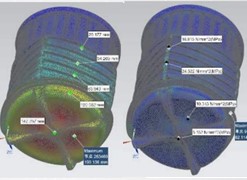
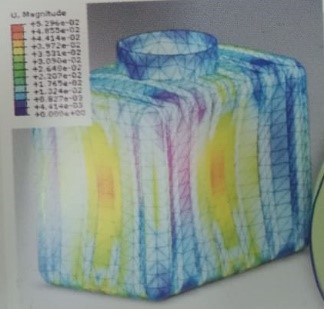
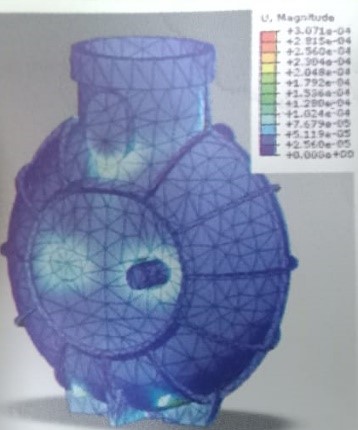
Therefore, it is necessary to design new structures using modern calculation methods, such as the finite element method, which will take into account the loads that occur in products, such as underground tanks, for example, at ground pressure. Due to the wide range of parameters of recycled plastic, industrial practices often encounter the problem of highly stressed products being processed with recycled polyethylene, which can lead to their failure during use. Therefore, thirdly, an equally important task is to develop a rapid method for detecting internal stress in products using ultrasonic flaw detection. Solving this problem will allow for timely adjustments to composite formulations, minimizing internal stress and extending the service life of the products. Thus, the development and implementation of new technologies for recycling secondary polyethylene, quality control using ultrasonic flaw detection, and the optimization of product designs (based on the finite element method) are promising areas that will significantly improve the environmental situation and increase the efficiency of plastic waste utilization.